
The global fashion industry produces over 92 million tons of textile waste annually, with a staggering 73% ending up in landfills or incineration. Simultaneously, the demand for Refuse-Derived Fuel (RDF) as an alternative energy source is skyrocketing. Bridging these two realities—transforming discarded clothing into valuable fuel or recycled fiber—requires a critical first step: shredding. But not all shredders are created equal. When tackling the unique challenges of textiles, from denim and carpets to blended fabrics, the choice between a single shaft and a double shaft shredder is pivotal. This guide cuts through the confusion, explaining which technology wins for textile processing and why, with insights from industry leader ForceShredder.
The Textile Challenge: Why Shredding is Complex
Before diving into machine types, it’s essential to understand what makes textiles a difficult material to process. Unlike rigid plastics or metals, textiles are:
- Tough & Fibrous: They resist tearing and can wrap around rotating parts.
- Elastic & Tangling: Materials like spandex or knits can stretch and entangle, jamming equipment.
- Blended & Inconsistent: Fabrics often combine natural fibers (cotton, wool) with synthetics (polyester, nylon), requiring versatile processing.
- Bulky & Lightweight: Loose clothing or rolls of fabric can be difficult to feed consistently.
An effective shredding solution must overcome these hurdles to produce a consistent output, whether for downstream fiber reclamation or as fluff for RDF.
The Contenders: Single Shaft vs. Double Shaft Shredders
Both single and double shaft shredders play vital roles in recycling, but their mechanisms suit different stages and goals of textile processing.
Double Shaft Shredder: The Heavy-Duty Primary Reducer
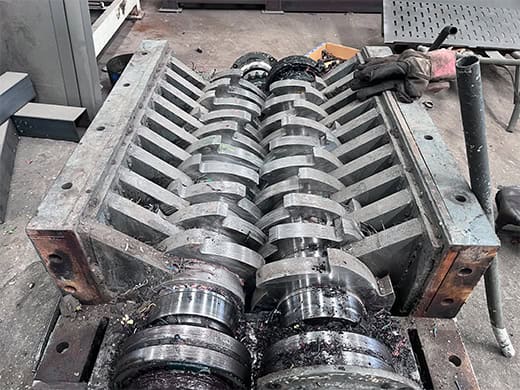
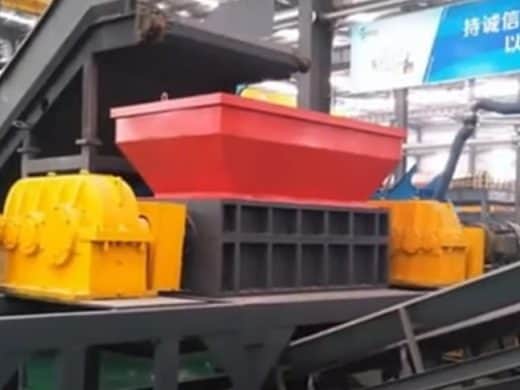
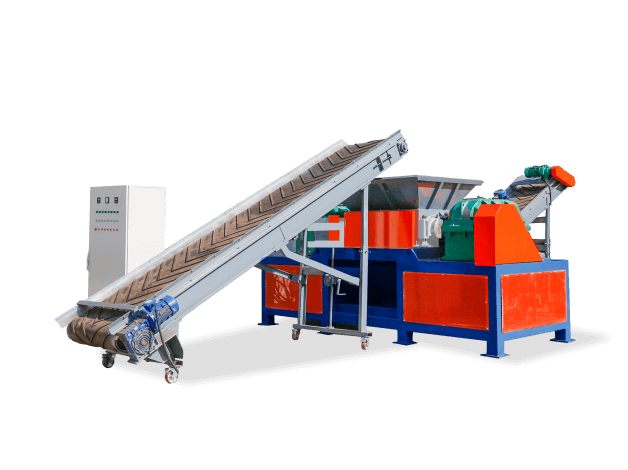
A double shaft shredder features two counter-rotating shafts with interlocking blades that grab, tear, and shear material at low speeds with extremely high torque.
- Best For: Primary reduction of bulky, large-volume textiles (bales of clothes, whole carpet rolls, mixed heavy textiles).
- Output: Coarse, irregular pieces (e.g., 50mm to 300mm). Ideal for volume reduction, landfill diversion, or preparing material for a secondary, finer shredder.
Single Shaft Shredder: The Precision Secondary Shredder
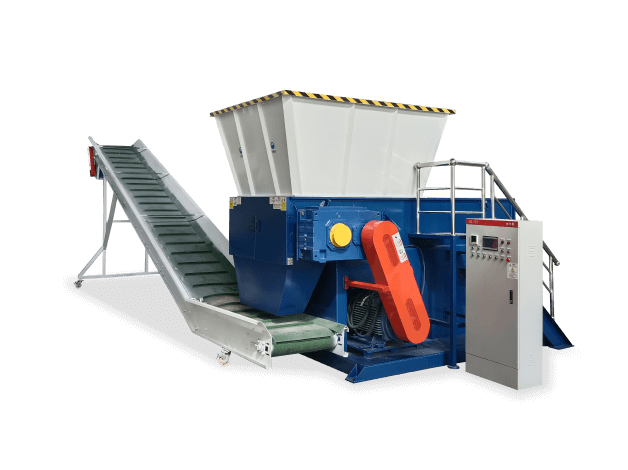
A single shaft shredder uses one rotating rotor equipped with cutting blades, working against a stationary counter-knife and a calibrated screen to control output size.
- Best For: Secondary shredding to a precise, uniform particle size. Ideal for producing high-quality fluff for RDF, or clean feedstock for fiber separation and pelletizing.
- Output: Fine, consistent granules or fluff (e.g., 10mm to 50mm), as defined by the screen size.
The Verdict: Which One for Textile Recycling & RDF?
For a complete and efficient textile-to-RDF or textile recycling line, the answer is almost always both. They are complementary technologies, not competitors.
However, if you must choose one as your primary or only machine, consider your goal:
Choose a Double Shaft Shredder if:
Your primary need is volume reduction and pre-processing of large, bulky textile waste (like unsorted post-consumer clothing, rags, or carpet rolls).
- You are feeding material that may contain contaminants like metal buttons, zippers, or hangers (the robust, low-speed design handles tramp metal better).
- Your downstream process (e.g., simple landfill diversion or baling for export) doesn’t require a fine, consistent particle size.
Example: A municipal waste facility needs to reduce the volume of textile waste streams before incineration or baling.
Choose a Single Shaft Shredder if:
- Your goal is to produce a high-quality, uniform RDF fluff or consistent feedstock for fiber opening/recycling. The screen controls output precisely.
- You are processing pre-sorted or pre-cut textiles and need a specific particle size for a boiler, gasifier, or pellet mill.
Example: An RDF production plant needs clean, 30mm textile fluff to mix with other waste streams for cement kiln fuel.
The Ideal System: A Two-Stage Process
For maximum efficiency and flexibility in turning clothing into RDF or recyclable fiber, a two-stage process using both machines is the gold standard:
1. Stage 1: Primary Shredding with a Double Shaft Shredder
Input: Whole bales of clothing, large carpet pieces, mixed bulky textiles.
Action: The high-torque, dual shafts open bales, tear apart large items, and reduce material to coarse, handlable pieces (approx. 100-200mm). This stage removes the risk of jamming a finer machine with raw, bulky waste. It also liberates some contaminants.
2. Stage 2: Fine Shredding with a Single Shaft Shredder
Input: Thecoarse output from the double shaft shredder.
Action: The single shaft shredder, with its controlled feeding rotor and sizing screen, further reduces the textile pieces to a precise, uniform particle size (e.g., 20-50mm). This creates the high-quality fluff essential for efficient combustion in RDF applications or for consistent material feed into fiber recycling equipment.
Why ForceShredder is Your Partner for Textile Processing
Navigating this choice and designing the right system requires expertise. ForceShredder, with over two decades of experience in solid waste treatment, offers precisely that.
Conclusion: A Strategic Partnership for a Circular Future
Transforming the mountain of textile waste into valuable resources like RDF or recycled fiber is a complex but essential task. The journey begins with choosing the right shredding technology. While a single shaft shredder excels at precision and a double shaft shredder at brute-force primary reduction, the most efficient and versatile solution for clothing-to-RDF is a two-stage system combining both.
By partnering with an experienced manufacturer like ForceShredder, you gain access not only to world-class equipment but also to the customized engineering and support needed to build a reliable, high-performance recycling line. It’s time to stop seeing discarded clothing as waste and start treating it as the valuable resource it is.